
Aurora Nexus / An international movement in the making
Female Lodges
We were given a seat at the table.Nobody asked us to redesign the room.What if we did?
In development. No affiliated Lodges, members or gatherings yet.
Concept image · not an existing Lodge
01 / A different architecture
Not another chair. A different architecture.
Female Lodges is a proposal for an international movement and societal infrastructure in which women do not merely participate in existing systems, but investigate together how those systems could be redesigned.
For all women. Every age, class and background. No degree, motherhood or life stage as an entry requirement. Lived experience and academic knowledge meet as equally valued sources — and can question one another.
Matriarchally inspired means reciprocity, relational responsibility, plural knowledge and shared authority. Not biological superiority or a hierarchy against men. Not a wellness club, networking group or guru model.
01Reciprocity
02Relational responsibility
03Plural knowledge
04Shared authority
The Roots / A legacy of questions
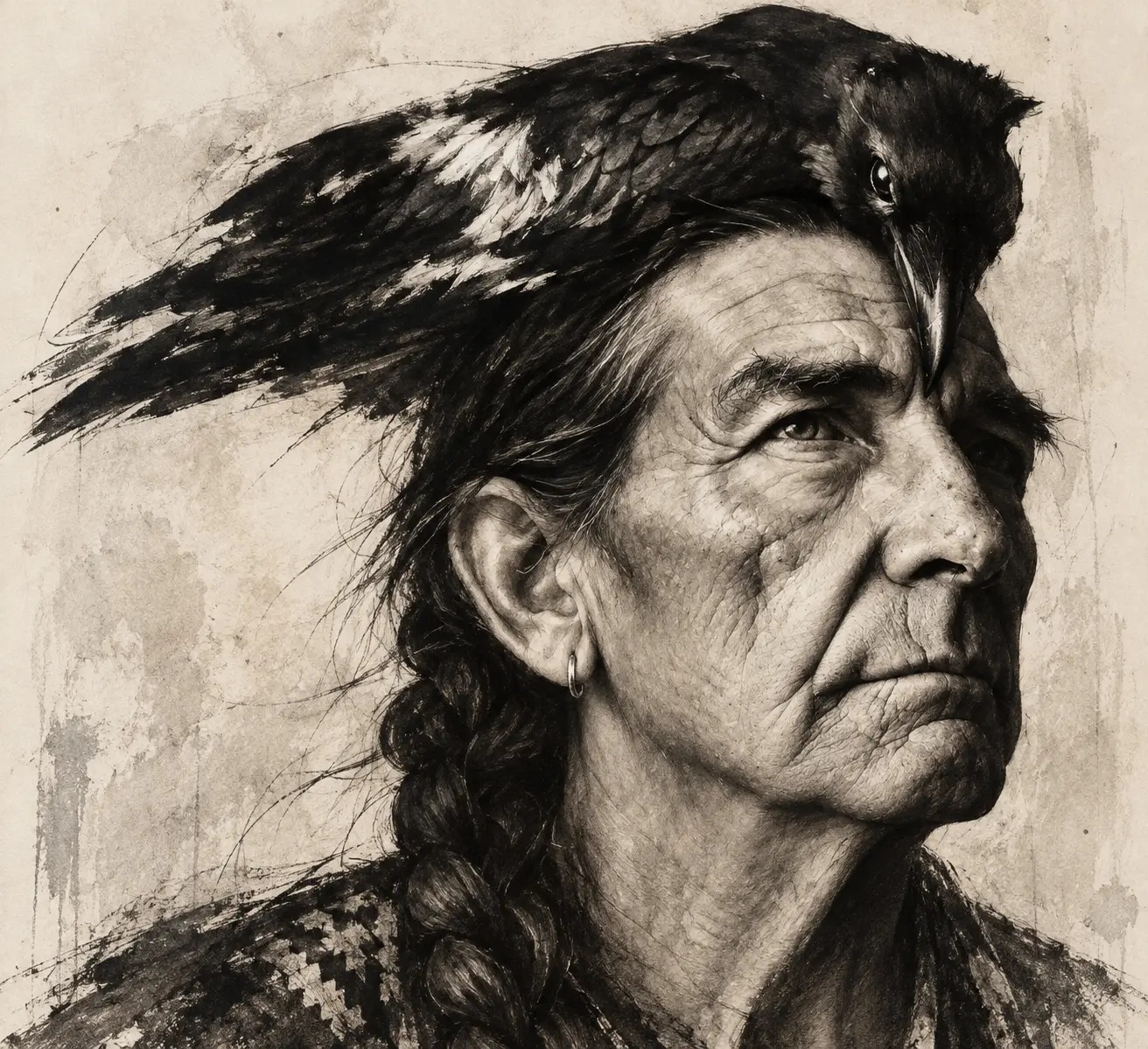
Charles Geerts.
The Snake.
Zoe Chè Chá
“He who sleeps with snakes” · as recorded in the interview
‘Ik moet mijn afkomst niet verloochenen.’His family story · origins, journeys and starting again
Jan Hertoghs describes how Charles’s mother came to Belgium around the Great Depression and did not return to Pine Ridge. According to the interview, Charles hitchhiked through the western United States in 1954 at seventeen. He received the name Zoe Chè Chá after two snakes settled in his backpack while he slept. This is his recollection recorded in the report, not independently confirmed family research.
After that journey he worked in the Camargue and served in the French Foreign Legion. He returned to Belgium in 1964. Working on the Antwerp docks, he found friends in a motorcycle club and encountered Belgium’s western scene. In the interview, his refusal to deny his origins sits at that crossroads: belonging without erasing himself.
‘Ik kan met heel weinig mijn plan trekken.’Charles Geerts, on travelling and camping · exact Dutch excerpt from the interview.
Later he speaks about what he learned in scouting and about travelling with his wife with little more than a pan and a coffee pot. For Ina this is not a prescription for others, but a personal legacy that opens questions about self-reliance, connection and room to follow one’s own path.
For Ina, her grandfather is not a symbol to borrow, but a personal history that keeps asking questions.
Ina De Quint identifies Charles Geerts as her grandfather and says his legacy inspires her daily. In journalist Jan Hertoghs’s interview, he is introduced as The Snake, the son of a Belgian father and a Lakota woman from Pine Ridge, South Dakota. His name and its explanation are presented here as recorded in the report.
This is an attributed family account, not independent genealogical research. Family history does not establish tribal membership or give Ina or Female Lodges authority to speak for Lakota communities. The movement is her contemporary proposal, not the continuation of an Indigenous institution.
Women, kinship & leadership in Lakota history
Research context · not a borrowed tradition
Kinship is more than a family tree.
The Smithsonian National Museum of the American Indian describes Oceti Sakowin kinship through extended family relationships, shared activities and responsibilities. The lesson spans several peoples and cites Dakota author Ella Cara Deloria, among others. This does not establish that all Lakota communities, historically or today, share one identical social or political model.
Women’s authority without a universal template.
The public abstract of Mary V. Bordeaux’s 2024 research describes conversations with six Lakota women using creative practices in their communities. It connects their experiences of leadership with kinship and relational responsibility. This is a specific, qualitative contemporary study — not a representative sample or a complete history of Lakota women. The abstract was consulted here, not the full dissertation.
Lakota is not Haudenosaunee.
The Onondaga Nation describes Clan Mothers as leaders with authority to select a representative and, after warnings, remove him. This is a specific Haudenosaunee governance practice. We do not project it onto Lakota history. The existence of women’s knowledge and authority does not justify simplifying Lakota societies as universally “matriarchal”.
Our editorial inference: relational responsibility can inform a question about our own design without adopting a Lakota concept, ceremony or title. This limited source selection does not replace Lakota historiography or voices from the communities themselves.
The Living Questions / 10
Not the final word. The first real question.
What changes when we question the arrangement, rather than the woman?
Ten editorial opening questions from Aurora Nexus. Not submissions, testimonials or active projects. Open a dossier: explore what is known, what is our interpretation and what might be different.
01CareIf care holds the world together, why must it fit around everything else?
Editorial opening question · not a submission
What the sources support
The ILO report on care work connects paid and unpaid care with inequalities in households and labour markets. It examines both recognition of unpaid care and the quality of paid care jobs. It does not establish that women are naturally better carers, or that every household divides work in the same way.
Our editorial interpretation
Designing the working day around someone without care responsibilities turns care into a private problem. Our starting point is not that women need more recognition so they can carry even more, but that time, money and responsibility can be distributed differently. The working conditions of paid carers belong in that conversation too.
An imaginable reality
Illustrative and fictional — not an actual testimonial.
A woman works changing shifts and helps her father attend appointments. Her brother wants to contribute, but every practical phone call comes to her. A flexible schedule for her alone leaves the division intact. Another woman provides paid home care; for her, flexibility means unpredictable income. The same solution does not automatically help both.
What we could redesign
Proposals to investigate; not proven solutions or active projects.
Make coordination time visible, not just hands-on care hours; renegotiate who plans and who acts.
Test predictable schedules and affordable cover with both people receiving care and paid care workers.
Assess a trial by redistributed workload and income security, not by how much more care women can manage.
Go deeper
Public sources, predominantly in English. Their findings do not automatically endorse our proposals. Source pages checked on 14 October 2026; no statistics or individual experiences inferred.
Both actions open a temporary contact draft below. Nothing is saved, sent or published.
02EconomyWhat do we call value when what keeps us alive does not count?
Editorial opening question · not a submission
What the sources support
The ILO treats unpaid care as work connected to the paid economy. Women, Business and the Law also examines how laws, policies and implementation shape women’s economic opportunities. These sources measure different things: care work is not the same as a legal right or an individual income.
Our editorial interpretation
A price tells us what is paid in a market, not everything society needs. Yet translating everything into money is not neutral either: it can turn relationships into transactions. The question is which decisions change when we also take time, dependency and material security seriously.
An imaginable reality
Illustrative and fictional — not an actual testimonial.
A municipal initiative calls volunteering cost-free. A retiree with a comfortable income can participate; for a single mother, the same hour means lost wages or childcare. The equal offer has unequal costs. This example does not describe an existing project.
What we could redesign
Proposals to investigate; not proven solutions or active projects.
Add an analysis of time and care costs to a budget before calling something “free”.
Budget for compensation, transport and care as core conditions of participation, not favours granted later.
Test an alternative against material security and relationship quality; let those involved define what is not for sale.
Go deeper
Public sources, predominantly in English. Their findings do not automatically endorse our proposals. Source pages checked on 14 October 2026; no statistics or individual experiences inferred.
Both actions open a temporary contact draft below. Nothing is saved, sent or published.
03PowerWho gets to set the agenda before everyone is invited?
Editorial opening question · not a submission
What the sources support
UNESCO’s 2025 Gender Report describes gender disparities in educational leadership and stresses the importance of context and personality. Women, Business and the Law distinguishes legal frameworks from conditions for implementation. Being present in an institution and actually having influence are therefore different research questions; a seat alone does not prove shared authority.
Our editorial interpretation
Power also lies in deciding what can be discussed, which language counts and when a decision is already settled. Diversity can remain symbolic when new participants may only respond to existing options. Shared authority requires clarity about decision rights and who can be held accountable.
An imaginable reality
Illustrative and fictional — not an actual testimonial.
A tenants’ group is invited to discuss a plan, but its budget and location are already fixed. One woman is asked to be “the diverse voice”. She does not automatically represent other tenants, and her presence does not by itself make the process inclusive.
What we could redesign
Proposals to investigate; not proven solutions or active projects.
State in advance what remains open, who decides and how a minority objection will be handled.
Let participants put questions and alternatives on the agenda, with compensation and accessible preparation.
Evaluate which proposals influenced the outcome; do not only count how many different people attended.
Go deeper
Public sources, predominantly in English. Their findings do not automatically endorse our proposals. Source pages checked on 14 October 2026; no statistics or individual experiences inferred.
Both actions open a temporary contact draft below. Nothing is saved, sent or published.
04KnowledgeWhen does experience become knowledge — and who gets to decide?
Editorial opening question · not a submission
What the sources support
The ILO analyses connections between care and labour markets; WHO describes how physical and social environments influence ageing. Such institutional sources can examine patterns, but do not document every individual life. Conversely, one experience can expose a blind spot without establishing how often it occurs.
Our editorial interpretation
Equal respect for people does not mean every claim carries the same evidential weight. A research method and a life story sometimes answer different questions. Intellectual care means taking both seriously, naming their limits and never requiring personal pain as an entry ticket.
An imaginable reality
Illustrative and fictional — not an actual testimonial.
An accessibility model labels a service reachable. A woman with limited energy explains that three transfers make the journey unusable. Her experience does not invalidate every accessibility measure; it does change the question that needs measuring. She need not disclose her medical records.
What we could redesign
Proposals to investigate; not proven solutions or active projects.
For each conclusion, record whether it is an observation, experience, interpretation or testable hypothesis.
Let people affected help define the research question and interpret results; pay for that expertise.
Allow disagreement and the choice not to disclose; publish experiences only with separate permission.
Go deeper
Public sources, predominantly in English. Their findings do not automatically endorse our proposals. Source pages checked on 14 October 2026; no statistics or individual experiences inferred.
Both actions open a temporary contact draft below. Nothing is saved, sent or published.
05AgeingWhat if growing older did not mean disappearing from public life?
Editorial opening question · not a submission
What the sources support
WHO stresses that there is no typical older person. Health in later life is shaped partly by social and physical circumstances and inequalities across the life course. Accessible buildings, transport and addressing ageism are part of its approach. Age predicts neither automatic wisdom nor identical support needs.
Our editorial interpretation
A community can idealise older women as wise carers while excluding them as decision-makers. Both images leave little room for ambition, fatigue, difference or refusal. Public participation should not depend on how much someone still does for others.
An imaginable reality
Illustrative and fictional — not an actual testimonial.
One woman wants to shape transport policy after retirement, not automatically serve the coffee. A contemporary wants to participate but avoids meetings without a resting place or transport. A third seeks paid work. They share an age group, not identical wishes or circumstances.
What we could redesign
Proposals to investigate; not proven solutions or active projects.
Design transport, seating, rest and remote participation with a diverse range of older participants.
Offer influence and paid work alongside voluntary roles; do not turn care into an age-based duty.
Ask each person what contribution they want to make and what support they need, without treating age as the answer.
Go deeper
Public sources, predominantly in English. Their findings do not automatically endorse our proposals. Source pages checked on 14 October 2026; no statistics or individual experiences inferred.
Both actions open a temporary contact draft below. Nothing is saved, sent or published.
06Enterprise & failureIs a second chance a right on paper, or a possibility in real life?
Editorial opening question · not a submission
What the sources support
Women, Business and the Law examines economic opportunities through laws, supportive policies and perceived enforcement. It shows why formal rules and implementation need separate examination. It is not a study of individual bankruptcies or a source for claims about Belgian debt discharge or social entitlements.
Our editorial interpretation
Starting again is not only about courage. Someone with time, a financial buffer and expert support can respond differently from someone rebuilding income and housing at once. Examining responsibility need not mean treating every consequence as a personal deficiency; structural criticism does not erase individual choices either.
An imaginable reality
Illustrative and fictional — not an actual testimonial.
Two entrepreneurs close similar businesses. One can recover for months with a partner’s income; the other must immediately find work while answering complex letters. Offering both the same inspiring restart programme does not equalise their starting positions. These are fictional situations, not Female Lodges cases.
What we could redesign
Proposals to investigate; not proven solutions or active projects.
Map practical barriers between formal rights and usable support with those affected.
Design early, understandable referral to recognised free support; leave legal advice to qualified professionals.
Assess recovery through rest, income and freedom of choice, not only the speed of a business restart.
Go deeper
Public sources, predominantly in English. Their findings do not automatically endorse our proposals. Source pages checked on 14 October 2026; no statistics or individual experiences inferred.
Both actions open a temporary contact draft below. Nothing is saved, sent or published.
07MotherhoodWhy call it an individual choice when the collective conditions are missing?
Editorial opening question · not a submission
What the sources support
The ILO connects the organisation of care with opportunities for paid work and inequalities within households. This supports examining leave, childcare and working conditions. It does not mean all mothers want the same thing, that every woman is a mother or that one family model should be the norm.
Our editorial interpretation
Freedom of choice becomes thin when every option creates losses borne mainly by one parent. Equity may require different support, not the same arrangement for every family. At the same time, women without children must not become the automatic backup for a poorly organised system.
An imaginable reality
Illustrative and fictional — not an actual testimonial.
A mother is allowed to work from home, but meetings still happen at school pickup time. Her colleague without children repeatedly covers the late shift. A solo parent cannot swap those shifts at all. What began as a personal favour creates new imbalances.
What we could redesign
Proposals to investigate; not proven solutions or active projects.
Make meeting times and schedules predictable for everyone; identify different care responsibilities without requiring private stories.
Examine shared leave and accessible childcare with attention to solo parents, low incomes and irregular shifts.
Check whether an adjustment shifts workload onto colleagues without children and redistribute it as a team responsibility.
Go deeper
Public sources, predominantly in English. Their findings do not automatically endorse our proposals. Source pages checked on 14 October 2026; no statistics or individual experiences inferred.
Both actions open a temporary contact draft below. Nothing is saved, sent or published.
08CommunityCan a community care without always resting on the same shoulders?
Editorial opening question · not a submission
What the sources support
The ILO report shows that the organisation and quality of care work matter. WHO describes the importance of supportive social and physical environments for ageing. Neither source proves that a women’s circle is automatically inclusive, accessible or sustainable; every design requires its own examination.
Our editorial interpretation
Reciprocity does not mean making everyone give precisely the same amount. A community can recognise unequal capacity without fixing people in the role of recipient or rescuer. Boundaries, compensation and the right to step away are part of belonging, not evidence of its absence.
An imaginable reality
Illustrative and fictional — not an actual testimonial.
An imagined neighbourhood group depends on three women who always book the room, translate and handle conflicts. New visitors experience warmth; the organisers become exhausted. Another person wants to attend but cannot afford entry. Attracting more participants does not solve that organisational question.
What we could redesign
Proposals to investigate; not proven solutions or active projects.
Make organisational and emotional labour visible; rotate tasks with proper handover and the right to decline.
Budget for coordination, translation and accessibility before expanding participation.
Agree how boundaries and conflicts will be handled; assess workload as well as connection.
Go deeper
Public sources, predominantly in English. Their findings do not automatically endorse our proposals. Source pages checked on 14 October 2026; no statistics or individual experiences inferred.
Both actions open a temporary contact draft below. Nothing is saved, sent or published.
09EducationDo we teach people to find their place, or also to question the arrangement?
Editorial opening question · not a submission
What the sources support
UNESCO’s 2025 Gender Report examines gender and educational leadership. It stresses that effective leadership cannot be reduced to gender. Its 2024 report examines when technology supports educational gender equality and when access, design or stereotypes create barriers. Distributing a device is therefore not the same as creating equitable learning opportunities.
Our editorial interpretation
Education can open access to existing institutions and provide tools to examine their assumptions. Critical learning takes more than letting everyone speak: those defining assignments, assessment standards and available examples must also be open to questioning.
An imaginable reality
Illustrative and fictional — not an actual testimonial.
An adult learner takes an online course alongside night shifts. The course is technically accessible but requires a live debate at the same hour every week. Another learner has time but little digital experience. One uniform entry point does not offer the same chance to learn or influence the course.
What we could redesign
Proposals to investigate; not proven solutions or active projects.
Offer different ways to demonstrate knowledge without silently lowering the substantive standard.
Let learners assess the accessibility of schedules, technology and examples, and visibly act on their criticism.
Examine who makes curriculum and assessment decisions; make leadership opportunities and support transparent.
Go deeper
Public sources, predominantly in English. Their findings do not automatically endorse our proposals. Source pages checked on 14 October 2026; no statistics or individual experiences inferred.
Both actions open a temporary contact draft below. Nothing is saved, sent or published.
10FreedomHow free is a choice you cannot afford to make?
Editorial opening question · not a submission
What the sources support
Women, Business and the Law distinguishes legal economic opportunities from the support and enforcement that make them usable. WHO describes how environments can support or constrain opportunities. These are different research fields, not a combined measure of freedom or evidence about one particular life.
Our editorial interpretation
Equality can mean everyone is allowed to open the same door. Equity also asks who can travel there, who has time and who can bear the risk of entering. Yet we must avoid deciding on someone else’s behalf what freedom should mean to them. Support should expand possibilities, not take over choices.
An imaginable reality
Illustrative and fictional — not an actual testimonial.
One woman is permitted to study but cannot lose working hours. Another can pay but cannot access the building. A third deliberately chooses not to participate. Respecting their choices requires distinguishing a preference, a barrier and an imposed norm.
What we could redesign
Proposals to investigate; not proven solutions or active projects.
Ask which concrete barrier makes a desired choice impossible before offering a solution.
Combine equal rights with different, freely chosen support and a straightforward right to stop.
Assess a design by the options genuinely available, including non-participation; let those affected define success.
Go deeper
Public sources, predominantly in English. Their findings do not automatically endorse our proposals. Source pages checked on 14 October 2026; no statistics or individual experiences inferred.
Both actions open a temporary contact draft below. Nothing is saved, sent or published.
02 / The first question
If you could redesign one thing about the world… where would you begin?
This is a contact draft, not a submission form. Your answers remain only on this page while it is open. Nothing is stored or sent.
Any future publication requires separate permission and human review. Do not include other people’s personal data, hateful content or sensitive details. Moderation and participation terms must be established before real submissions open.
03 / Perspectives
Not one voice. Five ways of seeing.
No hierarchy of expertise. An invitation to place knowledge alongside knowledge and keep one another thinking.
01ThinkersWho asks the question behind the question?
Who asks the question behind the question?
Investigate assumptions about success, care and authority. Which ideas do we take for granted — and who pays their price? Bring a question, not a doctrine.
02ResearchersWhat do we know — and what is missing?
What do we know — and what is missing?
Place research alongside experience. Ask who is missing from a sample, what a number cannot tell us and which knowledge goes unmeasured. Make methods and uncertainty open to discussion.
03BuildersHow do we make an alternative workable?
How do we make an alternative workable?
Turn an insight into a small testable design: a care agreement, an accessible space, a different decision process. Examine resources, responsibilities and possible unintended consequences.
04ChangemakersWhere can insight touch a system?
Where can insight touch a system?
Connect local questions to institutional choices. Who can change a rule? Who needs a say? Change requires accountability, not a hero narrative.
05Lived VoicesWhat does a life teach that a model misses?
What does a life teach that a model misses?
Bring knowledge from work, care, loss or starting again. You do not need a degree to validate your story or have to tell everything. Listening is participation; your experience will not be published without separate permission.
04 / The ecosystem
A movement needs more than a meeting place.
Five proposed parts. Not existing organisations or active projects: an architecture still to be developed.
A shared direction, not central command.
The proposed movement connects women across borders around shared principles. Local differences can remain; no one embodies the single correct voice.
How do we stay connected without becoming uniform?
05 / Future places
A global horizon. A local table.
A future Lodge would be rooted in its surroundings: local questions, accessible gatherings and shared responsibility. We are exploring how a first place might emerge. There are no locations, launch dates or registrations yet.
06 / Founding Voices
The first voices shape the questions.
Founding Voices is a proposed invitation to think together, not an existing membership circle. Prepare a draft of your interest below. No registration is recorded.
This is a contact draft, not a submission form. Your answers remain only on this page while it is open. Nothing is stored or sent.
07 / Origins & responsibility
A personal origin. Not a borrowed tradition.
My interest in women’s wisdom took on a personal meaning when I discovered that my biological grandfather was the son of a Lakota woman. For me, that family history is an invitation to learn and investigate: how can women’s experience, intergenerational knowledge and shared authority find a place in a community? From that question I am developing Female Lodges.
Among the Haudenosaunee, a confederacy of six Indigenous nations, Clan Mothers hold a significant societal role. The Onondaga Nation describes their role in selecting leaders, teaching generations and resolving conflicts. This is a specific, living tradition, not a universal model for Indigenous peoples or all women.
Ina’s Lakota family history is a separate personal account; it implies neither tribal membership nor cultural authority. The four mountains story, shared with Cree elder John Crier, is another distinct source about eldership, not specifically women or menopause. Research on menopause in Indigenous contexts describes diverse experiences; age or biology does not automatically make someone wise. Female Lodges do not borrow rituals or traditional titles from these sources.
Recognition is not an obligation to provide unpaid care. Every woman chooses what she gives, what she investigates and what she keeps for herself.
Not taking over the world. Reshaping it together.
Female Lodges · Aurora Nexus · A proposal in development